Urgent Exporting Frozen Okra to USA: 7 Key Guidelines (2026)
Exporting Frozen Okra to USA
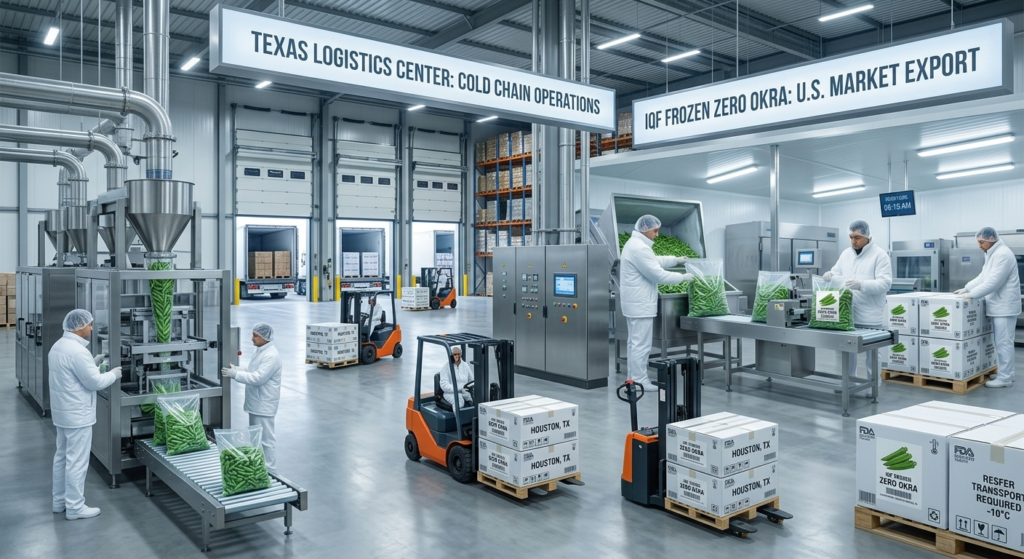
As demand for specialty frozen produce escalates across North American markets, international trade platforms have flagged an Urgent Spot Buying Signal for IQF Frozen Zero Okra. The primary destination for this high-grade commercial shipment is the distribution network centered in Houston, Texas.
1. Operational Drivers & Supply Deficit in the Texas Market
This immediate procurement demand stems from key structural factors across the U.S. food supply chain:
-
Accelerated Retail Consumption: Supermarket chains and specialty grocers serving Middle Eastern, Arab, and Hispanic communities in Texas are experiencing rapid sell-through rates for ready-to-cook oriental vegetables.
-
Cold-Storage Inventory Deficit: Seasonal demand spikes have depleted regional cold-storage reserves faster than anticipated, leaving a critical shelf-inventory gap that requires rapid reefer container replenishment.
The incoming shipments will directly supply major distribution hubs in Houston, Texas, serving retail networks across the state and surrounding regions.
2. Spot Buying Window Parameters
This trade opportunity is governed by a strict timeline requiring immediate supplier readiness and proposal submission:
| Parameter | Specifications & Conditions |
| Required Product | IQF Frozen Zero Okra (Premium Small Size). |
| Proposal Submission Deadline | September 25, 2026 |
| Deal Closure & Confirmation | October 1, 2026 |
| Destination / Delivery Point | United States – Houston, Texas. |
| Procurement Type | Urgent Spot Buying Window. |
3. Regulatory Standards for Exporting Frozen Okra to USA
To ensure seamless customs clearance at U.S. ports, exporting facilities must strictly comply with regulatory requirements:
-
U.S. FDA Registration: The processing plant must hold an active FDA facility registration and fulfill Prior Notice requirements before shipment dispatch.
-
Product Quality Standards (Zero Size): Strict calibration for ‘Zero’ size okra, individually quick-frozen (IQF) to maintain a free-flowing state, vibrant green color, and complete absence of visual defects or ice buildup.
-
Food Safety Certifications: Full compliance with FSMA requirements, backed by international safety standards such as HACCP, ISO 22000, or BRC.
-
Cold-Chain Logistics: Goods must be shipped in reefer containers maintained at a continuous temperature of -18°C throughout ocean transport.
4. Freight Logistics & Shipping Guidelines for Exporting Frozen Okra to USA
Successfully executing international shipments when exporting frozen okra to USA requires strict adherence to cold-chain logistics protocols. Given the perishable nature of frozen produce, maintaining product integrity from the processing facility to the final cold-storage warehouse in Houston, Texas, is critical.
-
Temperature Monitoring: Reefer containers must be pre-cooled to -18°C (-0.4°F) prior to loading. Automated data loggers must be active throughout ocean transit to provide continuous temperature verification for import inspection.
-
Packaging Integrity: Okra pods must be packed in food-grade polyethylene bags inside heavy-duty corrugated master cartons to prevent crushing during palletization and maritime transport.
-
Customs Documentation: Ensure that the Bill of Lading (B/L), Phytosanitary Certificate, Certificate of Origin, and Commercial Invoice accurately match all details submitted under the FDA Prior Notice filing.
5. Export Packaging & Private Labeling Specifications
When preparing commercial orders for exporting frozen okra to USA, packaging specifications must align with local retail and food service standards in Texas. Proper presentation reduces handling friction and speeds up distribution:
-
Retail vs. Food Service Sizing: Products should be packed in either 400g/1lb retail pouches designed for grocery display or 10kg bulk master cartons tailored for food processors and commercial kitchens.
-
Barcoding & Labeling Compliance: Outer cartons must feature clear English labeling including nutritional facts, net weight, country of origin, lot numbers, and barcode readability compatible with U.S. inventory systems.
-
Palletization Standards: Shipments should utilize standard ISPM-15 heat-treated wooden pallets or plastic pallets, strapped and stretch-wrapped securely to withstand handling at port terminals.
6. U.S. Port Inspection & Quality Assurance Measures
U.S. Customs and Border Protection (CBP) alongside the FDA enforce strict physical and biological inspections upon container arrival at Gulf Coast ports like Houston:
-
Pesticide Residue Limits (MRLs): Produce must strictly comply with Environmental Protection Agency (EPA) maximum residue limits to pass chemical clearance tests without delay.
-
Defect Calibration Limits: Shipments are evaluated for pod uniformity, fiber content, and damage tolerances. Premium Zero Okra must maintain less than 2% visual defects per commercial batch.
-
Defrosting Safeguards: Any evidence of partial thawing or refreezing during transit will lead to immediate container detention at the terminal level.
7. Strategic Takeaways for International Exporters
This spot buying window presents a high-margin commercial opportunity for frozen vegetable processors to capitalize on premium spot-market prices while securing long-term trade relationships with key U.S. importers. Exporters with compliant stocks of frozen produce, including related items like IQF strawberries or artichokes, can leverage this window for broader trade agreements.
📥 Access the Full Buying Signal & Connect Directly with the Buyer
Do you have available stock matching the specifications for exporting frozen okra to USA?
Register your company on GlobTrade to unlock full buyer details for this Houston procurement lead, submit your commercial offer before the September 25, 2026 deadline, and finalize shipment terms directly.
👉 Click Here to Register and Submit Your Offer Now